

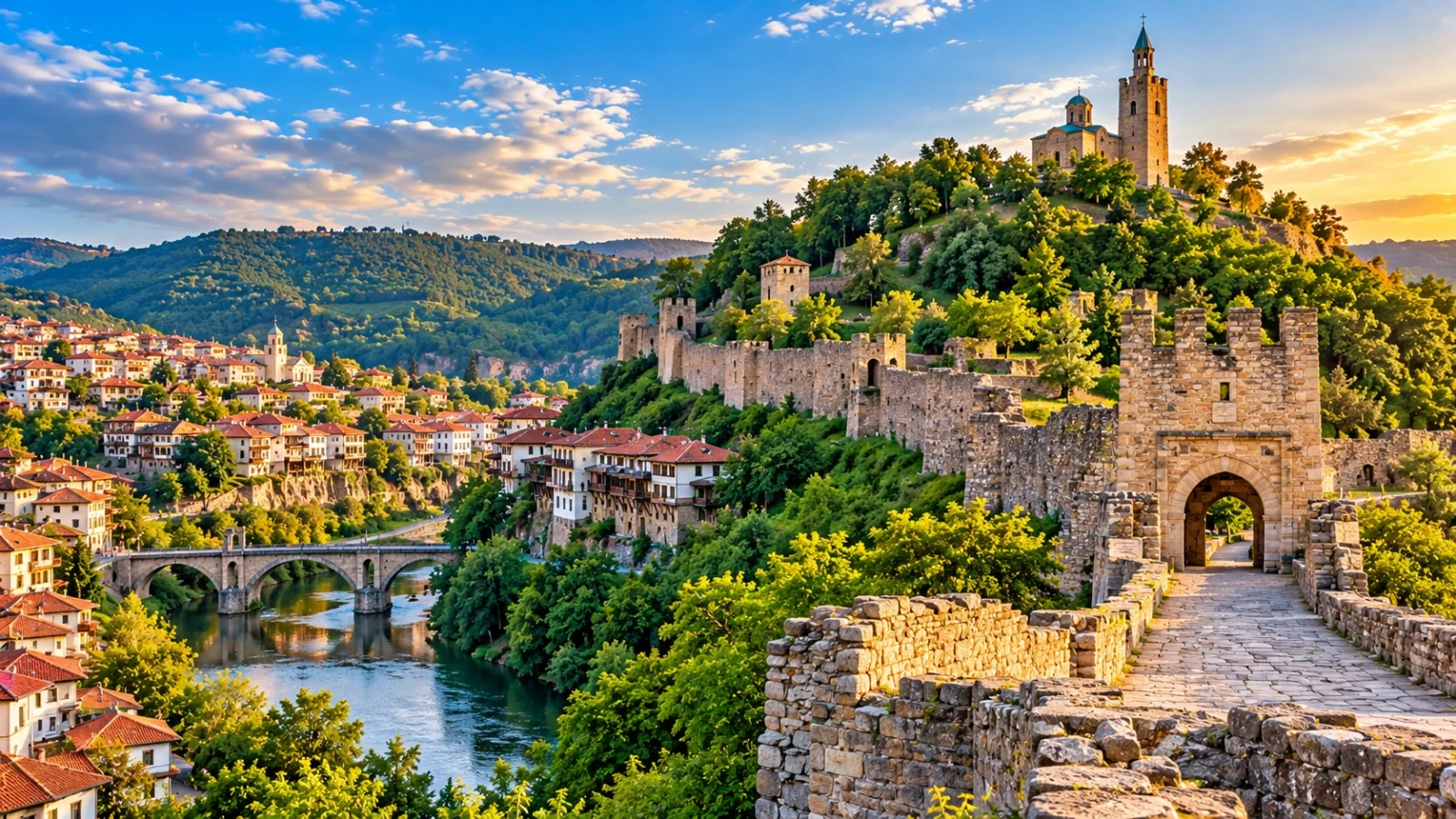
Veliko Tarnovo, Bulgaria, is a historic city known for its medieval fortress, traditional architecture, winding streets and spectacular views over the Yantra River. Once the capital of the Second Bulgarian Empire, it remains one of the country’s most rewarding destinations for travellers interested in history, culture and authentic Bulgarian experiences.
The city offers much more than a single famous landmark. You can explore the ruins of a medieval royal complex, browse traditional craft workshops, discover historic churches, walk along atmospheric streets and enjoy views across the hills and river valley. Nearby Arbanasi adds another dimension to the trip, with its traditional houses, courtyards and religious heritage.
Whether you are planning a weekend city break or including Bulgaria in a longer European journey, this guide covers the best places to visit in Veliko Tarnovo, things to do, local food, the best time to travel and practical advice for organising your itinerary.
1. Explore Tsarevets Fortress
Tsarevets Fortress is the most recognisable attraction in Veliko Tarnovo and the best place to begin exploring the city’s medieval history. The fortress stands on a prominent hill overlooking the Yantra River valley and was a major political, administrative and defensive centre during the Second Bulgarian Empire.
The historic complex contains sections of defensive walls, fortified entrances, towers, archaeological remains and the reconstructed Patriarchal complex near the summit. Walking through the site gives visitors a better understanding of how the medieval capital was organised and defended.
Start near the main entrance and follow the uphill paths towards the higher sections of the fortress. Along the way, look for surviving stonework and remains that indicate the scale of the settlement. Allow enough time to explore rather than simply climbing to the top for photographs.
Visitor tip: The terrain is uneven and includes uphill walking, so wear comfortable shoes and carry water in warmer weather. Check the official Tsarevets visitor information for current opening arrangements and admission details before travelling.
2. Discover Samovodska Charshia
Samovodska Charshia is a traditional crafts district that offers a different perspective on Veliko Tarnovo from its medieval fortifications. Located in the historic Varusha area, it is known for its workshops, small shops, galleries and buildings associated with Bulgaria’s National Revival period.
Spend time browsing the workshops and looking for handmade souvenirs, decorative objects and locally produced crafts. Depending on the business and time of day, you may also see artisans working. The experience is less about ticking off a monument and more about discovering the city’s creative and commercial traditions.
The surrounding streets are worth exploring at a relaxed pace. You can combine a walk through the district with a coffee break or a meal nearby, making it a convenient stop between larger attractions.
If you are looking for a meaningful souvenir, consider something made by a local craftsperson rather than a mass-produced item. Product availability varies, so browse several shops before deciding.
3. Walk Along Gurko Street and Explore the Old Town
Gurko Street is one of the most picturesque places to explore in Veliko Tarnovo. Traditional houses follow the hillside above the Yantra River valley, creating a distinctive streetscape of stone walls, wooden balconies and historic façades.
Walking through this area helps you appreciate the city’s relationship with its landscape. Buildings occupy different levels of the hillside, and the views change as you move through the streets. Look beyond the main route for small lanes and viewpoints that reveal different angles of the old town.
This is also a good place to slow down. Stop for a meal, enjoy a café or take time to photograph the architecture. Some buildings are private homes or businesses, so respect residents’ privacy when taking pictures.
The streets can be steep, and certain sections may have uneven paving. Plan your walk around your fitness level and allow extra time if you want to explore beyond the main street.
4. See the Monument to the Asen Dynasty
The Monument to the Asen Dynasty commemorates rulers associated with the Second Bulgarian Empire. Its dramatic central sword and sculptural figures make it a distinctive landmark in the city.
The monument stands in an open setting overlooking the Yantra River and surrounding hills. It is a worthwhile stop for visitors interested in the historical figures who shaped medieval Bulgaria, as well as for travellers seeking scenic views and photography opportunities.
You do not need to spend a long time here. Walk around the monument, take in the surrounding landscape and consider how it connects with the city’s wider historical story.
The monument can be combined with a visit to central Veliko Tarnovo, depending on your route and accommodation location.
5. Enjoy the Views Over the Yantra River
The Yantra River is central to the landscape of Veliko Tarnovo. Its curves through the valley, together with the surrounding hills and historic buildings, give the city much of its distinctive appearance.
Rather than searching for just one viewpoint, enjoy the scenery as part of your exploration of the old town. Elevated streets and open areas provide opportunities to see how the river winds around the historic hills.
The views change with the weather and season. Clear days can reveal the contrast between the river, greenery and traditional buildings, while mist and softer light can create a different atmosphere.
For photography, try capturing the relationship between the historic town and the river rather than focusing exclusively on individual buildings. Always remain on safe paths and avoid unstable edges when taking photographs.
6. Visit the Church of the Holy Forty Martyrs
The Church of the Holy Forty Martyrs is one of the most historically significant religious buildings in Veliko Tarnovo. Located near Tsarevets Hill, it is closely associated with Bulgaria’s medieval rulers and the history of the Second Bulgarian Empire.
The church is linked to Tsar Ivan Asen II’s victory at the Battle of Klokotnitsa in 1230. Its historical significance also comes from its connections with royal history and medieval inscriptions.
Its location makes it practical to combine the church with Tsarevets Fortress during the same sightseeing outing. If you are particularly interested in Bulgarian history, allow time to understand the site’s historical context rather than treating it as a quick stop.
Check current access arrangements and photography rules before your visit. As it is a religious site as well as a historical attraction, be respectful if services or other religious activities are taking place.
7. Explore Other Historic Churches
Veliko Tarnovo has several other churches associated with different periods of Bulgarian history. Depending on your interests, you could research the churches of St Peter and Paul and St Demetrius before deciding which to include in your itinerary.
These buildings offer opportunities to learn about religious art, architecture and the role of churches in the city’s historical development. Interior access, however, can vary by location and date.
Check visitor information in advance instead of assuming every church will be open throughout the day. If you have limited time, prioritise the sites that best match your interests and group nearby visits together.
When visiting, dress appropriately, keep noise to a minimum and follow any restrictions on photography.
8. Discover Veliko Tarnovo’s Museums
The city’s museums help explain the history behind the monuments, streets and archaeological remains you see during your visit. They are particularly valuable if you want to go beyond sightseeing and understand the region’s development across different historical periods.
The Regional History Museum includes several sites and collections. Depending on opening arrangements, you may be interested in the Archaeological Museum, the Museum of Revival and Constituent Assembly, or historic house museums.
The Museum of Revival and Constituent Assembly is relevant to visitors interested in Bulgaria’s modern political history. Veliko Tarnovo played an important role after liberation from Ottoman rule, including the adoption of the Tarnovo Constitution in 1879.
Before planning a museum visit, check which locations are open, their admission arrangements and how much time you need. The museum sites are not necessarily all in one building, so checking their locations can help you avoid unnecessary journeys.
For background and visitor planning, consult the Regional History Museum information on Visit Bulgaria.
9. Watch the Tsarevets Sound and Light Show
The Tsarevets Sound and Light show presents Bulgarian history through coordinated lighting, music and sound using the fortress as its backdrop. It offers a different experience from exploring the ruins during daylight, transforming the walls and towers into part of an evening performance.
If the show interests you, check the official Sound and Light website before planning your evening. The website publishes upcoming performances and ticket information, and shows should not be assumed to take place every night.
Check the designated viewing location, ticket requirements and arrival instructions for your chosen date. Some performances may have special arrangements, so rely on the current official schedule rather than older travel articles.
This can be a memorable addition to a visit, especially for travellers who enjoy history presented through a visual performance. If a show is not scheduled during your stay, you can still explore the historic centre and enjoy its evening atmosphere.
10. Try Traditional Bulgarian Food
Sampling Bulgarian food is a worthwhile part of a visit to Veliko Tarnovo. Local restaurants and bakeries provide opportunities to try familiar national dishes alongside regional specialities.
Start with banitsa, a pastry commonly made with layers of dough and a filling that often includes cheese and eggs. It is a popular breakfast or snack. Shopska salad, typically prepared with tomatoes, cucumbers, peppers and grated white cheese, is another well-known Bulgarian dish.
For a more substantial meal, look for grilled meats, soups, bean dishes and kavarma, a slow-cooked dish whose ingredients and preparation can vary. Menus differ between restaurants, so ask staff about ingredients if you have allergies or dietary requirements.
You can keep your meals simple: pick up a pastry for breakfast, enjoy a casual lunch while sightseeing and choose a restaurant for dinner. This leaves more time to explore without making every meal part of a rigid schedule.
11. Take a Day Trip to Arbanasi Village
Arbanasi is a historic village near Veliko Tarnovo and one of the most worthwhile additions to a longer stay. It is known for traditional houses, historic churches, courtyards and architecture associated with Bulgaria’s past.
The village has a different atmosphere from the steep urban streets of Veliko Tarnovo. Its historic residential buildings and cultural sites make it a good place to explore at a slower pace.
Notable places include the Konstantsaliev House, the Church of the Nativity and the Church of the Archangels Michael and Gabriel. Opening arrangements can vary, so check access before travelling, particularly if a specific building is central to your plans.
Allow time to walk through the village rather than visiting just one attraction. You can reach Arbanasi by arranging local transport, a taxi or a guided visit. Confirm your return journey in advance if you are relying on public transport.
For official destination information, see the Bulgarian Ministry of Tourism’s guide to the Arbanasi Archaeological Reserve.
12. Choose the Best Time to Visit Veliko Tarnovo
The best time to visit Veliko Tarnovo depends on your priorities, but spring and autumn can be attractive seasons for walking around the historic centre and exploring outdoor sites.
Spring
Spring can offer comfortable conditions for sightseeing, although rain and changing temperatures are possible. Bring layers and footwear suitable for hills and uneven streets.
Summer
Summer provides longer daylight hours and opportunities for outdoor dining and evening activities. However, climbing around the fortress and walking uphill can be tiring in hot weather. Start outdoor sightseeing earlier when possible, take breaks and carry water.
Autumn
Autumn can be pleasant for exploring historic streets and photographing the surrounding hills. As daylight becomes shorter later in the season, plan outdoor attractions accordingly.
Winter
Winter can be quieter, but cold conditions and shorter days may affect your plans. Check transport schedules and attraction opening arrangements, especially if you want to visit sites outside the centre.
Whatever season you choose, confirm the latest details for museums, paid attractions and special events before travelling.
13. How Many Days Do You Need in Veliko Tarnovo?
Two days is a useful starting point for a first visit. It gives you time to see the main historic attractions without rushing, with an opportunity to add museums, local food and a trip to Arbanasi if you have longer.
One day in Veliko Tarnovo
Start with Tsarevets Fortress, then visit the Church of the Holy Forty Martyrs if it is open. Spend the afternoon exploring Gurko Street and Samovodska Charshia, with time for a meal or a coffee break. If the Sound and Light show is scheduled for that evening, consider adding it to your plans.
Two days in Veliko Tarnovo
Use the first day for Tsarevets Fortress, the nearby church and the old town. On the second day, explore selected museums, visit other historic sites and spend more time browsing the craft district and enjoying local food.
Three days in Veliko Tarnovo
A third day gives you time to visit Arbanasi without rushing. You can also explore additional museums or historic sites depending on opening times and transport.
14. Getting Around Veliko Tarnovo: Practical Tips
Walking around the city
Walking is one of the best ways to explore the historic centre, but the hills make route planning important. Some streets have steep sections, steps or uneven paving. Wear comfortable shoes and allow more time than you might expect from looking at a map.
If you have mobility requirements, check individual routes and accessibility arrangements before booking accommodation or planning your daily itinerary.
Arriving by bus, train or road
Veliko Tarnovo is connected to other Bulgarian destinations by road and rail, but journey times and service frequency depend on the route. Check current timetables before booking onward travel, particularly if you have a tight connection.
If you are arriving from another country, compare the practical connections through larger Bulgarian cities before choosing an airport or onward route. Do not rely on an airport’s proximity alone; check flight availability and ground transport.
Choosing accommodation
Staying near the historic centre can make sightseeing more convenient. However, some accommodation is located on steep streets, which may be difficult with heavy luggage.
Before booking, check the property’s exact location, the walking route to nearby attractions and whether a vehicle can reach the entrance if needed.
Tickets and opening hours
Check official visitor information for Tsarevets Fortress, museums, historic churches and the Sound and Light show before travelling. Admission arrangements and opening times can vary, and not every historic site is open to visitors throughout the day.
Everyday essentials
Carry a payment card and some cash, and confirm payment options when necessary. Keep valuables secure in busy areas and ask restaurant staff about ingredients if you have dietary restrictions.
15. Frequently Asked Questions About Veliko Tarnovo, Bulgaria
Is Veliko Tarnovo worth visiting?
Yes. It is a strong choice for travellers interested in medieval history, traditional architecture, scenic viewpoints and Bulgarian culture. Tsarevets Fortress is the main attraction, while the old town, museums, churches and nearby Arbanasi provide more reasons to stay.
What is Veliko Tarnovo famous for?
Veliko Tarnovo is best known for its role as the capital of the Second Bulgarian Empire and for Tsarevets Fortress. The city is also known for Gurko Street, Samovodska Charshia, historic churches and views over the Yantra River.
How long should I stay in Veliko Tarnovo?
Two days is a practical starting point for most first-time visitors. One day allows you to see several major sights, while three days gives you more time for museums and a visit to Arbanasi.
Can you visit Veliko Tarnovo in one day?
Yes, but you will need to prioritise. Focus on Tsarevets Fortress and the historic centre, and check opening times and transport schedules before finalising your plan.
Is Tsarevets Fortress worth visiting?
Yes. It is the city’s defining historic attraction, with medieval fortifications, archaeological remains and views over the surrounding landscape. Allow enough time to explore the hill rather than treating it as a quick photo stop.
What places can you visit near Veliko Tarnovo?
Arbanasi is a convenient nearby destination, known for historic houses, churches and traditional architecture. Other regional historical sites may be suitable if you have extra time and transport.
Is Veliko Tarnovo easy to explore on foot?
The central historic areas can be explored on foot, but the city has steep streets and uneven surfaces. Comfortable shoes and a flexible itinerary are recommended. Travellers with mobility limitations should research specific routes in advance.
What food should you try in Veliko Tarnovo?
Look for banitsa, Shopska salad, grilled dishes, soups and Bulgarian specialities such as kavarma. Restaurant menus vary, so ask about ingredients if you have allergies or dietary requirements.
When is the best time to visit Veliko Tarnovo?
Spring and autumn can be pleasant for walking, while summer offers longer days for sightseeing. Winter can be quieter but colder. Check the forecast and attraction schedules before travelling.
Final Thoughts
Veliko Tarnovo, Bulgaria, combines medieval history, traditional architecture and a dramatic natural setting. Tsarevets Fortress explains the city’s historic importance, while Gurko Street and Samovodska Charshia offer a closer look at its older neighbourhoods and craft traditions.
The churches and museums add depth to a visit, and nearby Arbanasi makes a worthwhile extension if you have enough time. Whether you stay for one day or three, plan a manageable route, check current opening details and leave room to enjoy the city’s views and food.
If you are planning a wider European trip, explore Tatavel’s guide to the most beautiful places to visit in Europe for more destination inspiration.