

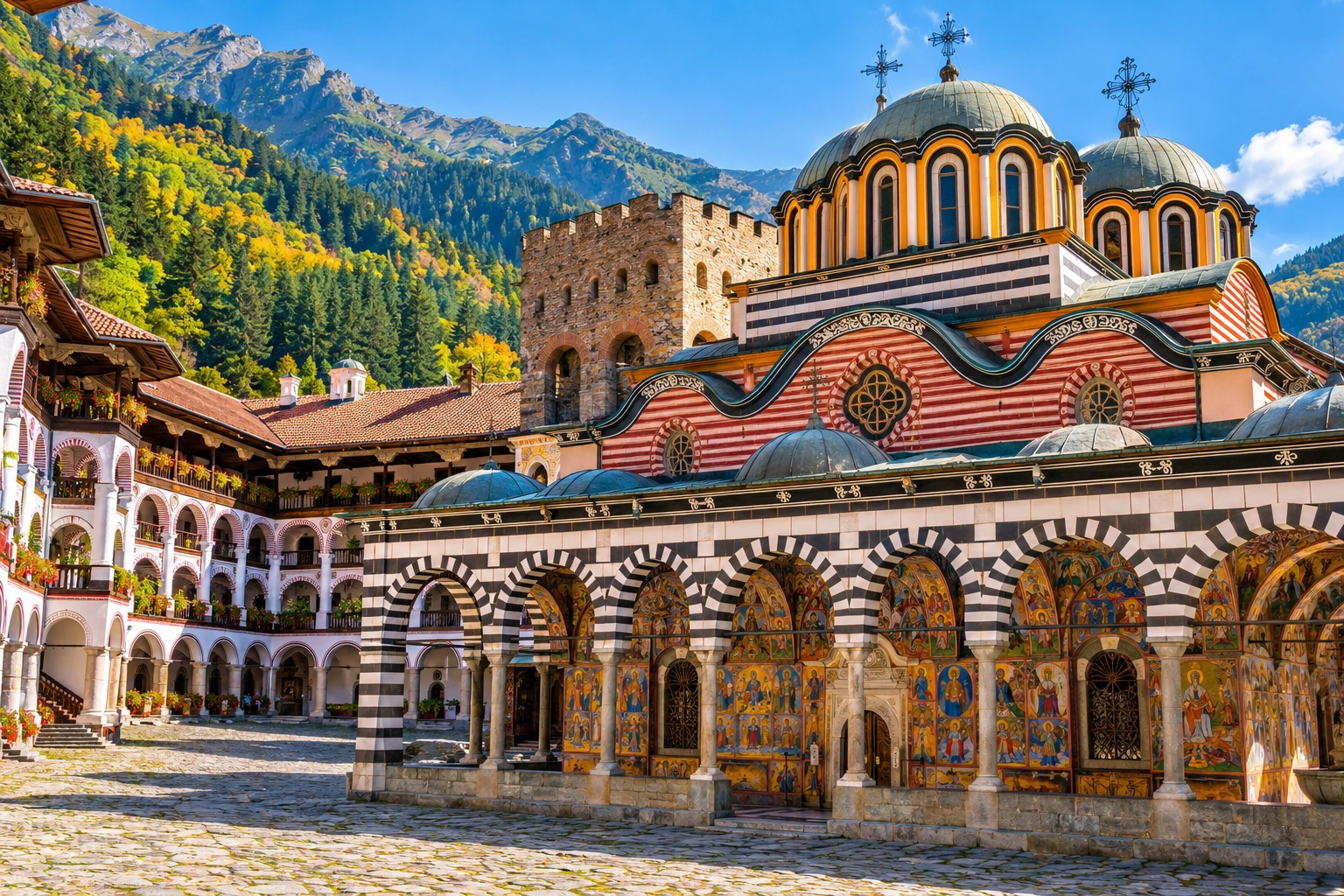
Rila Monastery is one of Bulgaria’s most remarkable cultural landmarks, set among the forested slopes of the Rila Mountains in southwestern Bulgaria. Famous for its colourful frescoes, striped arches, historic church and peaceful mountain surroundings, the monastery offers visitors a memorable introduction to Bulgaria’s religious heritage, architecture and history.
Founded in the 10th century and associated with Saint John of Rila, the monastery developed into an important centre of Bulgarian spiritual and cultural life. Its buildings and collections reflect centuries of religious devotion, artistic craftsmanship and the preservation of Bulgarian traditions. UNESCO recognised Rila Monastery as a World Heritage Site in 1983.
Whether you are planning a day trip from Sofia or exploring southwestern Bulgaria, Rila Monastery deserves more than a quick photo stop. The Church of the Nativity of the Virgin, arched courtyard galleries, medieval Hrelyo Tower and museum exhibitions provide plenty to discover, while the surrounding mountains create an impressive natural setting.
This complete travel guide covers the best things to see at Rila Monastery, how to get there, current published museum information, the best time to visit, nearby attractions and practical tips for planning your trip.
Why Visit Rila Monastery?
Rila Monastery is much more than an impressive historic building. It represents an important part of Bulgaria’s cultural identity and has played a significant role in preserving religious traditions, literature and artistic heritage.
The monastery developed around the legacy of Saint John of Rila, a hermit and spiritual figure whose life inspired the religious community associated with the site. Over the centuries, the complex experienced periods of growth, damage and reconstruction.
Much of the architecture visitors see today reflects the Bulgarian National Revival period. Following a major fire in the 19th century, the monastery underwent extensive rebuilding, creating much of the distinctive appearance that attracts visitors today.
The monastery continues to function as a religious community, making it both a historic landmark and an active place of worship.
Here are the main reasons to include it in your Bulgaria itinerary:
- Distinctive architecture: Admire the colourful arches, wooden balconies, domes and stonework surrounding the central courtyard.
- Historic frescoes: Discover religious paintings that illustrate the artistic traditions of Bulgarian Orthodox Christianity.
- Cultural heritage: Learn about a site closely connected with Bulgaria’s spiritual and historical development.
- Museum collections: Explore religious art, historic objects and exhibitions about monastic life.
- Medieval architecture: See Hrelyo Tower, a surviving structure associated with the monastery’s earlier history.
- Mountain scenery: Enjoy a peaceful setting among the forested slopes of the Rila Mountains.
Rila Monastery is particularly rewarding for travellers who want to explore Bulgaria beyond its major cities. It combines history, art, architecture and natural scenery in a single destination.
Where Is Rila Monastery Located?
Rila Monastery is situated in the Rila Mountains of southwestern Bulgaria, approximately 1,147 metres above sea level. Bulgaria’s Ministry of Tourism places it around 120 kilometres by road from Sofia and approximately 41 kilometres from Blagoevgrad.
The monastery lies in a mountain valley surrounded by forested slopes. Its location gives the complex a quieter atmosphere than the country’s main urban attractions.
Travellers coming from Sofia generally follow the Struma motorway south before taking the route towards the town of Rila and the monastery. The final section passes through countryside and mountain scenery.
Sofia is a convenient starting point for international visitors because it offers a wide choice of accommodation, rental cars and organised excursions. Travellers already exploring southwestern Bulgaria may find it easier to include the monastery in a regional itinerary.
Because the destination is outside the capital, arrange transport in advance. Traffic, weather and road conditions can affect journey times, particularly during winter.
Best Things to See at Rila Monastery
The main courtyard is the natural starting point for exploring Rila Monastery. Its architecture, religious artwork and historic buildings reveal different aspects of the complex’s cultural heritage.
Although the church and colourful galleries attract most visitors, the museum collections and smaller architectural details are also worth exploring.
1. Visit the Church of the Nativity of the Virgin
The Church of the Nativity of the Virgin is the central religious building within Rila Monastery. Its domes, decorative exterior and richly painted surfaces make it one of Bulgaria’s most recognisable historic landmarks.
The church occupies the visual centre of the courtyard, surrounded by the monastery’s distinctive galleries and residential buildings. The contrast between the colourful religious architecture and the stonework of the surrounding structures creates a memorable setting.
Inside, visitors can appreciate the religious artwork, icons and decorative features associated with Bulgarian Orthodox Christianity. These elements reflect the importance of religious art in the history of the monastery.
The church remains an active place of worship, so access and visitor movement may be affected by services or religious observances. Enter respectfully, follow posted instructions and check whether photography is permitted.
Take time to appreciate the architectural details instead of rushing through for photographs.
2. Admire the Famous Frescoes
The frescoes are among the most striking artistic features of Rila Monastery. Their vivid colours, detailed figures and religious scenes offer insight into the traditions of Orthodox Christian art.
Look closely at the painted surfaces around the church and courtyard. The imagery combines religious narratives with decorative patterns, creating a visual experience closely connected with the monastery’s spiritual purpose.
The frescoes are especially interesting for travellers who enjoy historic painting, architecture or cultural heritage. Even without specialist knowledge of religious art, visitors can appreciate the craftsmanship and scale of the decoration.
Allow time to observe the paintings rather than viewing them only from a distance. Their arrangement across the architectural surfaces helps explain why the monastery is considered one of Bulgaria’s most significant cultural sites.
Follow local rules on photography, particularly inside the church and museum exhibitions.
3. Explore the Arched Courtyard Galleries
The arched galleries surrounding the central courtyard are among the defining features of Rila Monastery. Their repeating patterns, painted surfaces and wooden balconies give the complex its distinctive appearance.
Walk around the courtyard to appreciate the architecture from different angles. Some viewpoints frame the church between the surrounding buildings, while others reveal the height and scale of the residential galleries.
The galleries demonstrate how the monastery combines practical buildings with decorative architectural features. Their arrangement creates a striking contrast between the arches, wooden elements, stonework and colourful church.
For photography, try capturing the relationship between the galleries and the church rather than focusing exclusively on close-up details. Wider compositions help communicate the size and character of the courtyard.
Remember that the courtyard is shared by worshippers, residents and visitors. Keep walkways clear and avoid disturbing religious activities.
4. See Hrelyo Tower
Hrelyo Tower is a medieval structure associated with the earlier history of Rila Monastery. Dating to the 14th century, it contrasts with the more decorative architecture of the main courtyard.
The tower reflects an earlier phase in the development of the complex. Its robust appearance differs from the colourful galleries and church buildings that dominate the present-day visitor experience.
For travellers interested in medieval architecture, the tower adds another dimension to the visit and helps illustrate how the monastery evolved over several centuries.
Access arrangements may differ from those of the main courtyard. If entering the tower is important to your itinerary, confirm its opening hours and visitor rules through the official Rila Monastery website.
5. Visit the Monastery Museums
The monastery’s museum exhibitions provide additional context for its history, religious traditions and daily life.
The official website lists several exhibitions, including the Church History Museum, an icon exhibition, displays about the monastery’s economy, ethnographic collections, historic guest rooms and Hrelyo Tower among its museum attractions.
The Church History Museum is particularly relevant for visitors interested in the monastery’s development and religious heritage. Its collection includes historic manuscripts, printed books and other objects connected with the monastery’s history.
One notable object is Raphael’s Cross, a celebrated example of Bulgarian miniature woodcarving. Created by the monk Raphael in the early 19th century, the intricately carved cross is known for its remarkable detail and craftsmanship.
The museum collections can help visitors understand the complex beyond its architecture. If you are interested in Bulgarian history, allow extra time to explore them.
Museum admission is separate from simply walking through the main courtyard. Some exhibitions may require visitors to contact staff for access.
Check the official museum information page for current opening hours, prices and guided-tour information.
6. Notice the Woodcarving and Traditional Craftsmanship
Some of the monastery’s most interesting details are easy to overlook when visitors concentrate only on the church and frescoes.
Look at the wooden balconies, doors, carved features and decorative fittings. These elements complement the stonework and painted surfaces, demonstrating the craftsmanship used throughout the complex.
The combination of wood, stone, plaster and painted decoration gives the monastery much of its visual character. Different architectural elements work together to create a setting that is both practical and richly detailed.
Visitors interested in design and photography may find that close-up images of these features complement wider photographs of the courtyard.
Avoid touching historic surfaces or religious objects, and respect restrictions on access to individual buildings.
7. Enjoy the Mountain Setting
The surrounding Rila Mountains add another dimension to the visit. Forested slopes, a mountain valley and changing seasonal colours create a striking backdrop for the historic complex.
Spring and summer can bring greener landscapes, while autumn may offer colourful woodland scenery. Winter can transform the area with snow, although colder temperatures and road conditions require additional preparation.
The mountain setting creates a welcome contrast with the urban atmosphere of Sofia. The journey itself offers an opportunity to appreciate another side of Bulgaria.
However, do not assume that visiting the monastery automatically includes an easy hiking experience. Walking beyond the main complex requires separate planning, especially in poor weather or during winter.
How to Get to Rila Monastery from Sofia
Transport is an important part of planning your visit. Rila Monastery is outside Sofia, and reaching it by public transport is less straightforward than visiting attractions within the capital.
Your best option depends on your budget, travel date, comfort level and whether you want to visit other destinations along the way.
Organised Day Tours from Sofia
An organised day tour is one of the simplest choices for travellers who do not want to drive or coordinate several transport connections.
Tours may include return transport from Sofia, a guide and additional stops, depending on the operator and itinerary.
Before booking, check:
- The departure point and return location.
- The total duration of the excursion.
- How much time is allocated to Rila Monastery.
- Whether museum admission is included.
- Whether other attractions are included.
- The cancellation policy and any additional charges.
Some tours combine several destinations into one day. Although this can be convenient, it may reduce the time available to explore the monastery.
For first-time visitors, a tour focused mainly on Rila Monastery may provide a more relaxed experience than an itinerary with numerous stops.
Driving to Rila Monastery
Driving gives you greater control over your departure time and how long you spend at the monastery.
The route from Sofia generally follows the Struma motorway south before continuing towards the town of Rila and the monastery. Bulgaria’s Ministry of Tourism identifies the junction near Kocherinovo as part of the route to the complex.
The final section passes through countryside and mountain scenery. Parking facilities are available near the monastery, but check current arrangements and any charges before travelling.
A rental car can be useful if you want to explore additional destinations in southwestern Bulgaria. However, mountain weather can affect driving conditions, particularly during winter.
Check the weather forecast and road information before leaving, and allow additional time if conditions are poor.
Public Transport to Rila Monastery
Do not rely on older travel guides that list a direct public bus from Sofia without verifying whether the service still operates.
The monastery’s official visitor information should be your first point of reference. If you prefer public transport, investigate connections to a nearby transport hub and confirm how you will travel the remaining distance to the monastery.
A connection to Blagoevgrad may be one possibility to investigate, but do not assume that onward transport will be available at a convenient time.
Before departure, verify the complete route for your actual travel date, including the return journey. If you cannot confirm a practical round trip, an organised tour or rental car is likely to be easier.
Can You Visit Rila Monastery on a Day Trip?
Yes. A day trip from Sofia is practical for many travellers if transport is arranged in advance.
Allow enough time for the journey in both directions, the main courtyard, the church and any museum exhibitions you want to visit. If you book a tour, check how much time you will actually spend at the monastery rather than judging the excursion only by its total duration.
Avoid combining too many distant attractions into one day. A relaxed visit gives you more time to appreciate the monastery’s architecture, artwork and history.
Rila Monastery Opening Hours and Museum Tickets
The main church and museum exhibitions have different visiting arrangements. Check the official information before departure because schedules can change.
The monastery’s published museum information lists the following general arrangements:
- Regular museum hours: 8:30 am to 4:30 pm.
- Summer museum hours: From 1 June to 30 September, the website lists extended hours of 8:30 am to 7:30 pm.
- Combined museum ticket: €12 for the exhibitions covered by the combined ticket.
- Guided tours: English- and French-language tours are listed at €15, with a duration of approximately 50 minutes.
These details relate to the museum exhibitions, not necessarily every building. The main church, Hrelyo Tower and individual exhibitions may have different opening arrangements. Some exhibition spaces may require staff assistance.
Tickets are sold on the monastery grounds rather than through the official museum webpage. Do not assume you can purchase a valid museum ticket online.
Before travelling, confirm current prices, opening arrangements and guided-tour availability through the official museum page and the official contact page.
If you are visiting around a religious service, public holiday or a tightly scheduled excursion, checking in advance is particularly important.
Best Time to Visit Rila Monastery
Rila Monastery can be visited in different seasons, but the best time depends on your preferred weather, transport arrangements and interest in the surrounding mountains.
Spring: Fresh Landscapes and Cooler Weather
Spring can be a pleasant time to explore the monastery and surrounding countryside. As the season progresses, the landscape becomes greener and the mountain scenery provides a refreshing contrast with the city.
Temperatures can remain cool, and rain may affect outdoor plans. Conditions at higher elevations can differ from those in Sofia.
Bring layers and comfortable footwear. If you plan to explore beyond the courtyard, check the weather and walking conditions before setting out.
Summer: Longer Days for Sightseeing
Summer offers longer daylight hours, making it easier to organise a day trip and spend time exploring the complex.
It is also a popular travel period, so visitor areas and organised excursions may be busier. Arriving earlier can give you more time to explore the courtyard and museum exhibitions without rushing.
Carry water and a light layer because mountain conditions may differ from those in Sofia. If you intend to visit other attractions, confirm transport arrangements and opening times beforehand.
Autumn: Woodland Colours and Scenic Views
Autumn can appeal to travellers who enjoy photography and natural scenery. The changing colours of the surrounding woodland provide a different backdrop for the monastery.
Cooler temperatures and shorter daylight hours become more noticeable as the season progresses. Plan your return journey carefully, especially if you are driving or using pre-arranged transport.
Autumn can be a good choice for visitors who want to appreciate the landscape as well as the monastery’s historic architecture.
Winter: Check Conditions Before Travelling
Winter brings the possibility of snow, cold temperatures and difficult road conditions. The monastery may remain accessible, but you should not assume that every journey will be straightforward.
Check road conditions, confirm transport and wear suitable footwear. If driving, ensure that your vehicle is equipped for the conditions.
Walking routes and nearby mountain attractions may require considerably more preparation in winter than the monastery courtyard itself.
How Long Should You Spend at Rila Monastery?
The time you need depends on your interests and transport arrangements.
Use these estimates as a starting point:
- Around one hour: A quick look at the courtyard and accessible architectural features.
- Two to three hours: A more comfortable visit covering the main courtyard, church and selected museum exhibitions, subject to opening arrangements.
- Half a day or longer: Additional time for museum collections, a guided tour and a carefully planned nearby attraction.
These are planning estimates rather than official visit durations. Actual time depends on which buildings are open, visitor numbers and how thoroughly you want to explore the collections.
If you are travelling from Sofia, remember that the return journey takes a significant part of the day. Build your itinerary around realistic travel time rather than treating the monastery as a quick stop between several distant attractions.
What to Know Before You Go: Visitor Checklist
Use this checklist to prepare for a smoother visit to Rila Monastery.
- Check the official website: Confirm museum opening times, prices and access arrangements shortly before travelling.
- Arrange transport both ways: Verify your return journey before leaving Sofia.
- Bring suitable clothing: Choose modest clothing for a religious site and layers for changing mountain conditions.
- Check photography rules: Follow posted instructions, particularly inside the church and museum exhibitions.
- Carry essentials: Bring water, a charged mobile phone and a suitable payment method.
- Allow enough time: Avoid scheduling several distant attractions around a short monastery visit.
- Respect the site: Keep noise low, avoid disturbing worshippers and follow staff instructions.
These simple preparations can help you focus on the history, architecture and atmosphere rather than dealing with avoidable travel problems.
Best Places to Visit Near Rila Monastery
If you have additional time, several attractions in the wider region are worth considering. However, distances, transport connections and walking requirements vary, so plan each stop carefully.
1. The Cave of Saint John of Rila
The cave associated with Saint John of Rila is a religious site connected with the traditions surrounding the monastery’s founding.
Saint John lived as a hermit in the mountains, and his spiritual legacy remains central to the monastery’s history. Visiting the cave offers a different experience from exploring the main courtyard and provides another perspective on the region’s religious heritage.
Check directions and walking conditions before visiting. The route may be more demanding than walking around the monastery buildings, particularly in wet, icy or snowy weather.
Allow sufficient time for the visit and return journey instead of trying to fit it into a tightly scheduled excursion.
2. Rila Monastery Nature Park
The surrounding natural landscape appeals to visitors interested in forests, mountain streams and outdoor activities.
Walking routes vary in length and difficulty, so choose an activity that matches your fitness, experience and available time. The mountain environment can change quickly, making weather checks and appropriate preparation essential.
If you are unfamiliar with the area, seek guidance from an official visitor information service or a qualified local guide before undertaking a demanding route.
Do not attempt a long mountain walk simply because you have spare time after visiting the monastery.
3. The Town of Rila
The town of Rila lies along the wider route towards the monastery and can be relevant for travellers exploring the region.
Depending on your itinerary, it may be useful for local services or as part of a broader journey through southwestern Bulgaria. Whether it deserves a separate sightseeing stop depends on your interests and available time.
Check your route and transport arrangements before adding the town to a tightly planned day trip.
4. The Seven Rila Lakes
The Seven Rila Lakes are among Bulgaria’s best-known mountain landscapes. Their glacial lakes and surrounding peaks attract hikers and nature enthusiasts, but they should be treated as a separate excursion rather than an immediate extension of the monastery visit.
Reaching the lakes involves additional travel and may require substantial walking. Access, lift operations and trail conditions can vary by season, while mountain weather can change quickly.
If you want to visit both Rila Monastery and the Seven Rila Lakes, consider a longer itinerary or separate days for the two destinations. Research transport, trail conditions and seasonal access carefully before travelling.
Suggested One-Day Itinerary for Rila Monastery
This itinerary is intended for visitors who have arranged return transport in advance. Adapt the order to current opening hours, tour schedules and weather.
Morning: Explore the Main Courtyard
Begin by walking around the main courtyard and appreciating the monastery’s distinctive architecture.
Look at the arched galleries, wooden balconies and church exterior before moving on to the religious artwork. This initial walk helps you understand the layout of the complex and identify the features you want to explore more closely.
If the church is accessible, enter respectfully and follow the rules displayed on site.
Late Morning: Discover the Historic Features
Spend time appreciating the frescoes and architectural details. Look for the contrast between the decorative church and the surrounding buildings.
View Hrelyo Tower and check whether it is open to visitors during your trip. If you enjoy photography, capture both the wider architectural setting and the smaller details without obstructing other visitors.
Early Afternoon: Visit the Museum
If the museum exhibitions are open and fit your schedule, explore the collections to learn more about the monastery’s history and cultural role.
Check admission arrangements before travelling, and allow additional time if you have booked a guided tour.
If you prefer a shorter visit, concentrate on the exhibitions that most closely match your interests rather than trying to see everything.
Later Afternoon: Enjoy the Surroundings and Return
If you have sufficient time, suitable weather and confirmed transport, consider a nearby attraction or enjoy the surrounding landscape before leaving.
Keep your return journey in mind. If you are travelling on an organised excursion, follow the departure schedule. If travelling independently, leave a reasonable margin for the drive or other connections.
A carefully planned visit is generally more enjoyable than trying to combine the monastery with several distant destinations in one day.
Frequently Asked Questions About Rila Monastery
Where is Rila Monastery located?
Rila Monastery is in the Rila Mountains of southwestern Bulgaria, approximately 120 kilometres by road from Sofia and around 41 kilometres from Blagoevgrad.
Why is Rila Monastery famous?
The monastery is known for its religious significance, distinctive architecture, colourful frescoes and role in Bulgarian cultural history. It was added to the UNESCO World Heritage List in 1983.
Can you visit Rila Monastery without a guide?
Yes. Visitors can explore accessible areas independently, subject to current rules and opening arrangements. A guided tour can provide additional context about the monastery’s history, architecture and collections.
Is there an entrance fee for Rila Monastery?
The main courtyard and church have different admission arrangements from the museum exhibitions. The official website lists a combined museum ticket, but you should check current prices and access rules before travelling.
How much is the Rila Monastery museum ticket?
The official museum page lists a combined ticket costing €12 for the exhibitions covered by that ticket. Prices and arrangements may change, so confirm the latest details on the official museum website.
What are Rila Monastery’s opening hours?
The official museum information lists general hours of 8:30 am to 4:30 pm, with extended hours of 8:30 am to 7:30 pm from 1 June to 30 September. These are museum hours and do not necessarily apply to every building. Check the official website before your visit.
Is there a direct bus from Sofia to Rila Monastery?
Do not assume a convenient direct public bus is operating. Verify current services for your travel date, including the return journey. An organised tour or rental car may be more practical if you cannot confirm suitable connections.
Can you visit Rila Monastery from Sofia in one day?
Yes. A day trip is practical if you arrange transport in advance and allow enough time for both the journey and the visit. Additional mountain excursions may require a longer itinerary.
How long does a visit to Rila Monastery take?
A short visit may take around an hour, while two to three hours can allow a more comfortable exploration of the main courtyard, church and selected museum exhibitions. The time required depends on opening arrangements and your interests.
Is Rila Monastery open throughout the year?
The monastery is a year-round destination, but the opening hours and accessibility of individual buildings or exhibitions can vary. Check the latest visitor information before departure, particularly during winter.
What should you wear at Rila Monastery?
Choose modest clothing appropriate for an active religious site and follow any specific dress requirements displayed on the premises. Comfortable footwear and weather-appropriate layers are also advisable.
Can you take photographs inside Rila Monastery?
Photography restrictions may differ between areas. Check posted signs and follow staff instructions, particularly inside the church and museum exhibitions.
Is Rila Monastery suitable for children?
Families interested in history, architecture and cultural sightseeing may enjoy the visit. Keep children close in busy areas and explain the importance of behaving quietly and respectfully inside religious spaces.
Can you visit the Seven Rila Lakes on the same day?
It may be possible with carefully arranged transport, but the lakes require a separate excursion and additional time for travel and walking. Many visitors will find it more comfortable to plan the lakes and monastery on separate days.
Final Thoughts: Is Rila Monastery Worth Visiting?
Rila Monastery is one of Bulgaria’s most significant cultural destinations, bringing together centuries of history, religious art and distinctive architecture in a remarkable mountain setting.
Its Church of the Nativity of the Virgin, colourful courtyard galleries, medieval Hrelyo Tower and museum collections provide plenty to discover. The surrounding mountains also make the journey memorable, offering a contrast with the urban atmosphere of Sofia.
For visitors staying in the capital, Rila Monastery can be a rewarding day trip, provided transport is arranged in advance. Travellers who want to explore nearby religious sites or undertake mountain hikes should allow additional time rather than trying to fit every attraction into a single rushed excursion.
Before travelling, check the latest official visitor information, confirm transport and respect the monastery’s role as an active religious community.
With thoughtful planning and enough time to appreciate its architecture and history, Rila Monastery can become one of the highlights of a trip to Bulgaria.